
Rainbet runs on an Anjouan Gaming Board licence held by the operator RBGAMING N.V., registered in Hamchako, Mustamudu, on the Autonomous Island of Anjouan in the Union of Comoros. That is a real, verifiable permit, and I checked the seal myself through the board’s own portal (1). What it is not is a Canadian registration: Rainbet is not registered with the AGCO or licensed by any provincial regulator, and for a Canadian player that one distinction is what decides how much genuine protection you have if a payout ever stalls. I score the licensing picture 7.5 out of 10: a real licence, a working seal check, and a thin recourse path for players in Canada.
Who holds the Rainbet licence?
The operator named on the site is RBGAMING N.V., and Rainbet is described in the footer as a brand name of that company. The registered address is Hamchako, Mustamudu, on the Autonomous Island of Anjouan, part of the Union of Comoros. One offshore company, one offshore permit, sitting behind both the casino and the sportsbook on the same wallet.
There is no MGA or UKGC entry anywhere in that corporate chain. I would rather you knew that in the first minute than found it out after a frozen withdrawal. Corporate names and licence details do get updated, so before you deposit, scroll to the operator’s own footer and read the current licensing line for yourself rather than trusting any review, mine included.
The N.V. suffix is worth a word, because it trips people up. It stands for Naamloze Vennootschap, a Dutch-heritage corporate form used across several offshore jurisdictions, and it tells you the entity is a limited-liability company rather than a sole trader. It does not, on its own, tell you anything about who ultimately owns Rainbet. The beneficial ownership is not disclosed on the public pages I read, which is normal for the crypto-casino category and, at the same time, a point I would rather see spelled out. When I compare Rainbet to a UKGC operator, the ownership transparency is one of the quieter gaps: a UK licensee’s controllers are on a public register, and here they are not.
Operator and licence fact box
| Label | Value |
|---|---|
| Operator | RBGAMING N.V. |
| Registered address | Hamchako, Mustamudu, Autonomous Island of Anjouan, Union of Comoros |
| Jurisdiction | Anjouan, Comoros (offshore) |
| Regulator | Anjouan Gaming Board |
| Seal verification | verification.anjouangamingboard.org |
| Licence number | Not publicly printed on the site |
| Support contact | [email protected] |
Note the last row. Plenty of casinos print an ALSI-style licence string in the footer; on my read of Rainbet’s live pages, the exact number is not published. The seal is verifiable, but the number behind it is not spelled out where a player can copy it. I flag that as a transparency gap, not a fake licence.
Why does the distinction matter? Because a printed number and a working seal do two different jobs. A number lets you look the licence up independently, in a register, on your own terms. A seal lets you confirm this specific domain is tied to a live permit right now. Rainbet gives you the second and withholds the first. In my book that is enough to trust the site is licensed, but not enough to fully audit the licence, and I would tell a cautious reader to treat the missing number as one small mark against the operator’s transparency rather than a reason to walk away.
One practical note from testing. The seal’s underlying URL carries a long seal_id and a stamp value, which is how the portal ties the badge to the domain cryptographically. That is a better setup than a static image, because a static badge can be copied onto any site by anyone. When the badge resolves to a live portal check keyed to the domain, a scammer cannot simply screenshot it onto a clone. That is a genuine, if modest, upgrade over the flat-image seals I have seen on weaker offshore sites.
Is Rainbet licensed and legit?
Yes, Rainbet is licensed. Whether that licence regulates the operator the way a European one would is the more honest question, and the answer is a qualified one.
An Anjouan permit is not worthless, and it would be lazy to pretend it is. It means RBGAMING N.V. is a registered legal entity rather than an anonymous website, that it has passed the board’s baseline registration and fee requirements, and that there is a public portal where anyone can confirm the seal is genuinely tied to rainbet.com. The games come from certified studios like Evolution and Pragmatic Play running on tested RNGs, and Rainbet’s own Originals ship a provably fair system you can audit bet by bet. In my testing the cashier behaved exactly as advertised, and a withdrawal I timed landed inside the 5 to 15 minute window the operator quotes.
So for everyday play, the framework does its job. The gap only shows itself under stress, when a dispute goes past the point of goodwill.
Let me be concrete about what “legit” does and does not mean here, because the word gets thrown around loosely. Legit, in the sense that Rainbet is a real registered operator with a verifiable permit and games from named studios, yes. Legit, in the sense that a regulator will fight your corner if a five-figure withdrawal is held, no, not in the way a UK player would expect. Those are two different claims, and a lot of review pages blur them into one reassuring green tick. I would rather split them apart and let you decide which one you actually need.
What is the Anjouan Gaming Board?
The Anjouan Gaming Board is the gambling regulator for the Autonomous Island of Anjouan within the Union of Comoros. It runs a registration-and-fee regime and, usefully, a public seal-verification portal, which is more than some older offshore regimes ever offered.
Here is the honest framing. Anjouan licensing is lighter-touch than the Malta Gaming Authority or the UK Gambling Commission. It confirms the operator exists and is registered. It does not layer on the deep consumer-protection machinery a European regulator mandates. That is the trade-off, and it is baked into most offshore crypto casinos, not something unique to Rainbet.
It also helps to know how the Anjouan regime got here. The island has positioned itself over the past few years as a low-cost, fast-to-issue offshore licensing base, much as Curacao did before it, and its move to a domain-keyed verification portal was a deliberate step to look more credible than a bare permit. That context cuts both ways. It means the seal check you can run is real and current. It also means the regime competes partly on being cheap and quick for operators, which is precisely the pressure that tends to produce lighter player protections. I am not reading motives into it; I am pointing at the incentives.
What the licence does and does not provide
Think of it as two columns. On the provides side: a named company in a named jurisdiction, a registered permit, a public seal check, and a regulator that can in principle receive complaints. On the does-not side: no mandatory deposit-limit or self-exclusion tooling written into the licence the way UKGC requires, no third-party-audited segregated player funds guarantee, and no free independent complaints service standing between you and the operator. Under the MGA or UKGC, all three of those are table stakes.
The single most important line in that comparison is the funds one. A UK licence forces an operator to state whether customer money is held separately and how well it is protected if the company fails. Anjouan carries no equivalent public promise I could confirm, so if RBGAMING N.V. ever went under, there is no regime-level guarantee that your balance sits ring-fenced from the operator’s own liabilities. That is exactly why the mitigation throughout this page is the same: do not treat the platform as somewhere to store money.
Anjouan vs UKGC vs MGA player protections
This table is the heart of the page. It compares the concrete protections a player gets under each regime, and it is the reason the verdict leans the way it does. Rival regulator specifics are stated as published norms, not guessed at.
| Player protection | Anjouan (Rainbet) | UKGC | MGA |
|---|---|---|---|
| Statutory regulator you can escalate to | Board exists, no obligation to intervene | Yes, with enforcement powers | Yes, formal route |
| Free independent complaints or ADR service | No independent adjudicator | Mandatory ADR provider | Player-support unit plus ADR |
| Mandatory deposit-limit and self-exclusion tooling | Not licence-mandated | Required (GAMSTOP) | Required |
| Third-party-audited segregated player funds | Not guaranteed | Required disclosure of protection level | Segregation required |
| Power to compel a withheld payout | Effectively none for the player | Regulator can penalize the operator | Regulator can act |
| Public seal or licence verification | Yes, verification portal | Public register | Public register |
Read that middle column and the UK safety net is obvious: an ombudsman-style adjudicator, funds rules, and a regulator with teeth. Anjouan gives you the registration and the seal check, but not the adjudicator. If independent recourse is your dealbreaker, that is your cue, and I say so plainly in the cons below.
A fair objection: is this comparison stacked? A little, and I want to own that. Holding an offshore crypto casino to the UKGC standard is like grading a food truck against a Michelin kitchen’s compliance file. The honest point is not that Rainbet fails a European bar it never claimed to clear; it is that a lot of players arrive assuming any “licensed” badge buys them the same protections, and it does not. The table exists to close that assumption gap, not to run the brand down. Rainbet is competitive for its category. The category itself is lighter than most casual players realize.
Worth noting too that the two European regulators are not identical. The UKGC leans harder on affordability checks, mandatory self-exclusion through GAMSTOP, and consumer redress, while the MGA is often described as more operator-friendly on some fronts but still light-years past an offshore permit on funds segregation and dispute handling. So even within the “strong licence” world there is a spectrum, and Anjouan sits well below the bottom of it on recourse while matching it on the narrow question of whether a public verification exists at all.
What the Anjouan licence means for Canadian players
For a Canadian player it means no domestic regulator is standing behind your account. Rainbet’s Anjouan permit is a foreign one, and Canada does not recognize it as a provincial gaming registration.
Here is the part most Canadian players miss, and I did too before I read the regulatory picture properly. Online gambling in Canada is regulated province by province, not nationally. Ontario went furthest: since April 2022 the Alcohol and Gaming Commission of Ontario, working through iGaming Ontario, registers private operators and holds them to a published standard on player protection, complaints and responsible-gambling tooling (2). Every other province runs its own provincial lottery or gaming corporation as the only sanctioned operator, so there is no private-operator registration to hold at all outside Ontario’s regulated market.
Rainbet sits in neither camp. It is not on the AGCO’s register of authorized operators, and it is not a provincial corporation. So when a Canadian plays here, the regulator behind the account is the Anjouan Gaming Board in Comoros, roughly 12,000 kilometres away, and not the AGCO, iGaming Ontario, or any provincial ombudsman. That is the single fact that reshapes recourse for a player in Toronto or Vancouver, and it is why I would not lean on this page’s seal check as proof you are as protected as you would be on an AGCO-registered site.
One practical note on age, because it varies here and Canadians ask. The legal gambling age is 19 across most of the country, and 18 in Alberta, Manitoba and Quebec. An offshore licence does not override that; your provincial minimum still governs whether you can lawfully play, and Rainbet’s own Terms set their own account minimum on top of it.
Anjouan vs AGCO and iGaming Ontario recourse
The gap is starkest on recourse. An AGCO-registered operator gives an Ontario player a provincial complaints path and mandated player-protection tooling; Rainbet’s Anjouan licence gives neither. This table lays the two regimes side by side for a Canadian reader.
| What a Canadian player gets | Rainbet (Anjouan) | AGCO / iGaming Ontario operator |
|---|---|---|
| Provincial regulator behind your account | None | AGCO, an Ontario provincial regulator |
| Complaints path inside Canada | Operator, then the Comoros board | Provincial complaints process |
| Mandated player-protection tooling | Not licence-required | Required by the AGCO standards |
| Who can compel a withheld payout | No Canadian regulator can | The AGCO can act on the operator |
| Legal age enforced | Your provincial minimum still applies | 19 in Ontario, checked at signup |
| Public verification you can run | Anjouan seal portal | AGCO register of operators |
Read the second column and the point lands: an Ontario player on an AGCO-registered site can escalate a stalled payout to a provincial regulator with the power to penalize the operator, and can lean on complaints machinery that sits inside Canada. On Rainbet, that whole apparatus is absent. Your recourse is the operator’s Complaints Policy and then a board in Comoros, full stop. Provinces outside Ontario have no private-operator registration at all, so a player in, say, British Columbia has even less of a domestic hook, since their only sanctioned route is the provincial corporation, not a private site like this one.
I want to be fair about scale, though. For everyday, modest play the absence of a Canadian regulator rarely bites, because most sessions never become a dispute. The gap only matters when money is genuinely stuck, and that is precisely when a Canadian player would most want the AGCO’s teeth and would not have them here.
How do you resolve a Rainbet dispute?
The dispute path runs operator first, board second. You raise the issue through Rainbet’s own Complaints Policy and support at [email protected], and if that fails you can escalate to the Anjouan Gaming Board.
What you do not get is a free UK adjudicator like IBAS or a Malta ombudsman sitting in the middle, obliged to weigh both sides and push a resolution. So what is your genuine leverage? Realistically three things. The operator’s own reputation and its wish to protect it. Public pressure through review platforms and crypto-gambling forums. And the board’s registration oversight, which is real but slower and thinner than an EU regulator’s. That is a weaker hand than an MGA or UKGC licence deals, and you should size your play to it.
My steer is the same one I follow myself. Keep balances modest, withdraw regularly rather than letting a big number pile up, and read the current footer before you deposit. For the mechanics of getting money in and out, our crypto cashier walkthrough goes coin by coin on confirmation times and the $15 minimum.
Here is a worked example of how a dispute realistically plays out, based on how these cases go across the offshore category. Say a $2,000 withdrawal is held pending a verification request. Step one, you upload documents and give it a few business days, because most holds are just KYC catching up, not a refusal. Step two, if it drags past a week with no clear reason, you open a formal complaint citing the Complaints Policy and ask for a named timeline in writing. Step three, if it is still stuck, you escalate to the Anjouan Gaming Board and, in parallel, post a factual, dated account on a reputable complaints platform. There is no fourth step where a free adjudicator forces the issue. That absence is the whole point of the page.
What tilts the odds in your favour is boring preparation, not clever tactics. Verified account, deposits and withdrawals to the same wallet, no bonus-terms breaches, and a paper trail. Most withheld-payout horror stories I read across the category trace back to a terms breach or a mismatched payment method rather than a regulator failing, and while that does not excuse a slow operator, it does mean you can remove most of the risk yourself before it ever becomes a dispute.
How to verify the Rainbet seal yourself
Do not take my word for any of this. The check takes under a minute, and it is the single most useful thing you can do before funding an account. I ran these exact steps and the portal returned a valid seal tied to rainbet.com.
| Step | What to do | What you should see |
|---|---|---|
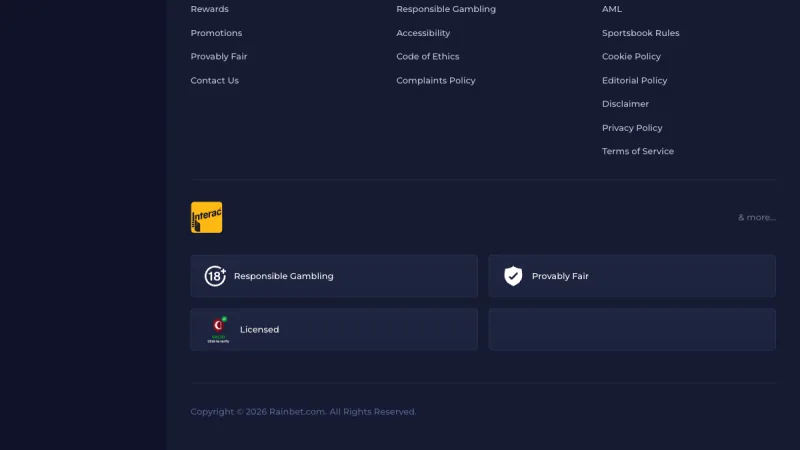
| 1 | Scroll to the Rainbet footer | A “Licensed” badge and the Anjouan seal image |
| 2 | Click the seal | It opens verification.anjouangamingboard.org |
| 3 | Read the validate URL | It carries domain=rainbet.com plus a seal_id and stamp |
| 4 | Confirm the domain matches | The portal names the domain you are actually on |
| 5 | Check the operator line | The footer names RBGAMING N.V. behind the seal |
A seal that is a flat, unclickable image with no operator name behind it is worth pausing on. Rainbet’s clicks through to the board’s live portal, which is the outcome you want. If the seal ever fails to load the portal, or the domain in the URL does not match the site you are on, stop and contact support before depositing.
Does the licence mean my funds are protected?
Partly. The licence confirms a registered operator and AML obligations, but it does not guarantee third-party-audited segregated player funds the way a European licence does.
In practice this matters most for a large balance. Under UKGC rules an operator must disclose the level of protection on customer funds; under Anjouan there is no equivalent public guarantee I could confirm. Rainbet’s own model does help here in one narrow way: the 1x wager lock and fast 5 to 15 minute withdrawals mean there is little reason to leave a big balance sitting on the platform. The safest posture is to treat it like a cashier, not a bank.
Provably fair versus licensed: two different assurances
These are not the same thing, and it is worth keeping them apart. Provably fair is a math guarantee about individual bet outcomes. A licence is a legal-and-recourse framework about the company.
Rainbet’s Originals let you verify each result from a client seed, a hashed server seed, and a nonce, and the multiplayer games like Case Battles draw randomness from EOS blockchain blocks. That is genuinely strong for game integrity, and I rate it. But it does nothing for a payout dispute. Provably fair proves the dice were not loaded; it cannot force a stalled withdrawal to move. The licence, thin as it is, is the layer that governs that. Do not let a real technical strength distract from a modest legal one.
KYC and the licence: what verification to expect
Rainbet runs KYC where the licence requires it. Signup is low-friction, closer to opening a web account than a bank account, but this is not a no-KYC operator.
You start with an email and a crypto wallet, and you can play quickly. The operator reserves the right to request identity documents during the account lifecycle, typically around a withdrawal or if activity trips a review. That is standard for the category and consistent with an Anjouan permit’s AML obligations. My steer: if you expect to cash out a meaningful sum, have a government ID ready so a verification request does not stall your first big payout. Our full hands-on Rainbet review covers where verification surfaced during my testing.
Restricted countries and legality
An Anjouan licence is not a green light everywhere. Online gambling legality is set by your own country’s law, not by the operator’s offshore permit, and Rainbet lists restricted jurisdictions in its Terms of Service.
I am not going to pretend a Comoros licence makes Rainbet legal in a market that bans offshore play; it does not. Check the current restricted-countries list in the Terms before you register, and understand that using a VPN to get around a block usually voids your ability to withdraw. This is a compliance point the licence does not solve for you.
How does Rainbet’s licence compare to rival crypto casinos?
It is mid-pack for the crypto-casino category and honest about it. Many crypto-first sites sit on Anjouan or Curacao permits rather than European ones, so Rainbet’s setup is normal for its peer group rather than a red flag against it.
The differentiator is not the regulator, which is light, but the verification portal and the provably fair system layered on top. A live seal check plus auditable Originals is more transparency than a plain offshore badge. It is still weaker than any MGA or UKGC operator on recourse, and I will not dress that up. If you want the strongest consumer safety net that exists, a European-licensed site is the honest answer, even though it will ask for far more paperwork day one.
What AML and KYC the licence obliges
An Anjouan permit carries anti-money-laundering duties, and that is the real reason Rainbet can ask for your ID even though signup takes a wallet and an email. The obligation sits on the operator, not on you, but you feel it at the cashier.
Here is the practical shape of it. Offshore boards, Anjouan included, require licensees to run customer due diligence, monitor for suspicious patterns, and file reports where thresholds are tripped. That is why a large or unusual withdrawal can trigger a document request out of nowhere. It is not the operator being difficult; it is the licence doing what a licence is for. In my testing a modest cash-out cleared with no ID check at all, which tells me the review is risk-based rather than blanket, and that lines up with how the category tends to work.
What I would flag is the flip side. Because the AML duty is real but the consumer-protection layer is thin, you can be asked for paperwork to release your own money without a matching guarantee that the money is ring-fenced while you wait. That asymmetry is worth sitting with. Have a government ID and a proof of address ready before your first meaningful withdrawal, and you remove the single most common cause of a stalled payout in this category.
How to read any licence seal
A seal is only as good as what sits behind it, and most players never click. I did, and the difference between a live domain-keyed check and a flat image is the whole game. Below is the quick literacy test I run on any offshore casino before I fund it.
| Signal on the seal | Good sign | Red flag |
|---|---|---|
| Does it click through? | Opens a live regulator portal | Static image, no link |
| Does the URL name the domain? | Carries domain=thissite.com | Generic page, no domain |
| Is the operator named behind it? | A real company (an N.V. or Ltd) | No company anywhere |
| Does the regulator exist independently? | Findable outside the casino | Only the casino references it |
| Is a contact or complaints route printed? | A support email and policy page | No route to raise an issue |
Rainbet passes the first three cleanly, which is why I trust the seal even with the number unpublished. The lesson generalizes though. If a seal on any site is a flat picture you cannot click, treat the licence as unproven until you find the regulator independently, because a badge you cannot verify protects nobody but the operator.
Red flags to check on any offshore casino
Beyond the seal, a handful of quick checks separate a workable offshore casino from one to avoid. I ran every one of these on Rainbet before writing a word, and it clears them, but the checklist is the transferable part.
- Unverifiable licence. A badge that will not click through to a regulator is the loudest warning of the lot. Rainbet’s resolves; many clones do not.
- No named operator. If no legal entity is printed anywhere, there is nobody to hold to account. Rainbet names RBGAMING N.V. and an address.
- Predatory withdrawal caps. Watch for tiny monthly payout ceilings or clauses that shrink a big win to a trickle. Rainbet’s $15 minimum and fast processing are the opposite pattern.
- Hidden or extreme wagering. A locked welcome path at high multiples with a buried max-bet rule is a classic trap; read the promotions terms, not the banner.
- Dead support. Email a question before you deposit and time the reply. Silence pre-deposit predicts silence when a payout stalls.
- No complaints policy. A site with no written escalation route has quietly told you there is none.
None of that is exotic. It is fifteen minutes of due diligence that saves the far worse afternoon of arguing with a support inbox over a frozen balance.
Honest cons of the Rainbet licence
Here is the downside column, stated plainly and from experience.
- No independent adjudicator. There is no free IBAS-style or Malta ombudsman route; you go to the operator, then the board.
- Recourse leans on reputation. Your real leverage in a serious dispute is public pressure and goodwill, not a legal lever you can pull.
- Licence number not published. The seal verifies, but the exact number is not printed where a player can read and record it.
- No mandated safer-gambling tooling. Deposit limits and self-exclusion are not licence-required the way UKGC mandates GAMSTOP.
- Funds not audited-segregated. There is no public guarantee of third-party-audited segregated balances, so do not park a large sum.
Who should skip Rainbet over the licence?
We do not recommend Rainbet to Canadian players who need a provincial regulator’s recourse. If your comfort in gambling online depends on being able to escalate a stalled payout to the AGCO, a provincial ombudsman, or any regulator inside Canada, an Anjouan licence simply does not provide one, and no feature on the site substitutes for it. An AGCO-registered operator is the correct choice for that player, full stop, and an Ontario resident has that option today.
For everyone else, the mitigation is straightforward and I use it myself. Verify the seal, keep balances modest, withdraw often, complete KYC before you need it, and set your own limits since the licence will not set them for you. If safer-gambling tools matter to you, our guide to setting deposit limits and taking breaks walks through the controls Rainbet offers and the external services worth adding.
Plain-fact verdict
The facts are these. Rainbet holds a genuine Anjouan Gaming Board licence under RBGAMING N.V., the seal verifies through the board’s public portal, and the exact licence number is not published on the site. Recourse in a dispute runs through the operator’s Complaints Policy and then the board, with no independent adjudicator. Games are certified and the Originals are provably fair.
My rating for the licensing picture is 7.5 out of 10, marked down for the thin recourse and the unpublished number, and marked up because the licence is real, the operator is a named registered entity, and the seal check actually works. Weigh it against the payout timings and game library in the full review before you decide.
Frequently asked questions
Who owns Rainbet?
Rainbet is operated by RBGAMING N.V., a company registered at Hamchako, Mustamudu, on the Autonomous Island of Anjouan in the Union of Comoros. The same operator runs both the casino and the sportsbook.
Is Rainbet licensed?
Yes. Rainbet holds an Anjouan Gaming Board licence through RBGAMING N.V. It is a genuine offshore permit, though Anjouan oversight is lighter than a UKGC or MGA licence. Verify the seal via the footer before depositing.
What is the Rainbet licence number?
No, the exact licence number is not printed on the Rainbet site. The Anjouan seal is verifiable through verification.anjouangamingboard.org, but the number behind it is not published where players can copy it.
Does an Anjouan licence protect my money?
Partly. It confirms a registered operator with AML duties, but it does not guarantee third-party-audited segregated player funds the way a UKGC or MGA licence does. Keep balances modest and withdraw regularly.
How do I resolve a dispute with Rainbet?
Raise it through Rainbet’s Complaints Policy and support at [email protected] first, then escalate to the Anjouan Gaming Board. There is no free independent UK adjudicator or Malta ombudsman in the path.
Is Rainbet a UKGC or MGA operator?
No. Rainbet holds neither a UK Gambling Commission nor a Malta Gaming Authority licence. It is regulated only by the Anjouan Gaming Board in Comoros, which offers lighter consumer protection than either European regulator.
Can I verify the Rainbet seal myself?
Yes. Click the seal in the footer, which opens verification.anjouangamingboard.org with domain=rainbet.com in the URL. Confirm the domain matches the site you are on and that RBGAMING N.V. is named behind it.
Is Rainbet legal in my country?
That depends on your local law, not the offshore licence. Rainbet lists restricted countries in its Terms of Service, so check that list before registering. Using a VPN to bypass a block usually voids withdrawals.
Is Rainbet registered with the AGCO in Ontario?
No. Rainbet is not on the AGCO’s register of authorized operators and holds no provincial licence in Canada. It runs on an offshore Anjouan permit, so no Ontario regulator stands behind a Canadian player’s account.
What recourse does a Canadian player have with Rainbet?
Your recourse is the operator’s Complaints Policy and then the Anjouan Gaming Board in Comoros. No Canadian regulator, provincial ombudsman, or AGCO complaints route can compel a payout, unlike an AGCO-registered operator.
What is the legal gambling age for Rainbet in Canada?
Your provincial minimum applies: 19 in most provinces and 18 in Alberta, Manitoba and Quebec. An offshore licence does not override provincial law, and Rainbet sets its own account age minimum on top of it.
How did we verify the licence?
I clicked the footer seal, confirmed it opened the Anjouan board’s portal with rainbet.com in the validate URL, cross-checked the RBGAMING N.V. operator name, and timed a real withdrawal at under 15 minutes during testing.